On Tuesday, November 7th, 2023, Segway made history. They announced the side-by-side industry’s first turbo-charged hybrid drivetrain—the Segway Super Villain.
Segway has also announced that the innovative hybrid machine will pack a whopping 330 horsepower, making it the first UTV ever to break 300 horsepower.
This new hybrid UTV from Segway has the potential to revolutionize the off-road industry—but will it deliver?

Let’s take a deep dive into the details we know about the new Super Villain and compare it to two other big releases in powersports in 2023—the Can-Am Maverick R and the Polaris RZR Pro R—to see just how revolutionary the new Segway Super Villain SX20 really is (or isn’t?!).
Segway released a ton of interesting facts about the Super Villain when it was announced. Let’s start with the engine(s).
The new Super Villain will have either a gas-powered engine or a more powerful hybrid option (the showstopper!).
| Gas-Powered Super Villain | Hybrid Super Villain |
|---|---|
| 2.0 L TGDI engine | 2.0 L TGDI engine + 7.9 kWh battery + 70 kw electric motor |
| 235 HP | 330 HP |
| 390 N⋅m torque | 570 N⋅m torque |
| 93 MPH top speed | 93 MPH top speed |
| 2,755 lb | 3,196 lb |

We can’t overstate the importance of horsepower and torque here. For decades, we’ve never seen a side-by-side pass the 300-horsepower mark. Several have come close, but the hybrid Super Villain is the first (stock) UTV to cross the threshold.
And with 570 N⋅m of torque, well… putting your foot down in the Super Villain hybrid may feel more like launching a rocket than driving a side-by-side. That’s all thanks to the instantaneous power delivered by the battery and electric motor.

As you’re riding, the gas engine charges the battery. Braking also charges the battery. Segway claims this will help the hybrid Super Villain maintain the highest fuel efficiency possible. Side-by-sides aren’t known for being gas savers, so this could be a real game-changer.
Being a hybrid, the Super Villain isn’t meant to run on the battery alone for long. That’s a good thing, since the powerful electric motor would drain the battery in about six and a half minutes.
The Super Villain’s hybrid capabilities will mostly come into play at low speeds and when starting from a dead stop—very much like a hybrid car—and it’ll deliver additional power to the wheels in concert with the 2.0 L TGDI engine when needed.

With the gas Super Villain, you’re getting about 12 pounds per horsepower versus about 10 pounds per horsepower with the hybrid. That’s about a 7% difference between the two—and it puts the gas-powered model comfortably in the same camp as the Can-Am Maverick R and the Polaris RZR Pro R (if you compare them pound-per-pound).
While top speed stays the same, you’re going to give up some horsepower and torque with the gas version, but it will definitely feel more nimble without the 441 pounds of added weight from the battery and the electric motor.

As for the cockpit, you’ll see a lot of familiar bells and whistles with this hybrid UTV. Ergonomic seats, paddle shifters, and an automotive-style dashboard are the most eye-catching features inside.
There’s a large in-dash display that shares music, controls vehicle and system settings, and important status information about your machine.
These touch-screen displays are becoming the standard in high-end side-by-sides, and we’re not surprised to see high-tech stylings in the Segway.

Now that we’ve unpacked the Super Villain’s key features, let’s compare it to the Polaris RZR Pro R and the Can-Am Maverick R.
| 2025 (?) Segway Super Villain SX20 Hybrid | 2024 Polaris RZR Pro R Premium | 2024 Can-Am Maverick R (base) | |
|---|---|---|---|
| Price | ? | $37,499 | $35,499 |
| Seats | 2 | 2 | 2 |
| Engine | 2.0 L TGDI | 999T DCT | Rotax 999T |
| Electric Motor | 70 kW/93 HP | – | – |
| Cylinders Displacement | 2000 cc | 1997 cc | 999 cc |
| Horsepower | 330 HP | 225 HP | 240 HP |
| Top Speed | 93 MPH | 90 MPH | 99 MPH |
| Transmission | 6-speed automatic | CVT | 7-speed automatic DCT |
| EPS | ✓ | ✓ | ✓ |
| Vehicle Dimensions | 140.5” x 76” x 71.6” | 136.5” x 74” x 8” | 138.7” x 78.1” x 67.7” |
| Cargo Bed Capacity | 300 lb | 300 lb | 200 lb |
| Wheelbase | 104.5” | 104.5” | 108” |
| Ground Clearance | 14.6” | 16” | 17” |
| Curb Weight | 3,196 lb | 2,144 lb | 2,150 lb |
| Pounds per HP | 10.325 lb | 9.72 lb | 9.375 lb |
| Front Suspension | 20” travel | 27” travel | 25” travel |
| Rear Suspension | 21” travel | 20” travel | 25” travel |
| Shocks | K-man 2.5” Damper System (3” rear) | 2.5” Walker Evans Velocity Needle Shock (3” rear) | 2.5” Fox Podium Piggyback |
| Wheels | 15” Aluminum with beadlock | 15” Painted cast aluminum rims 5-bolt | 15” Aluminum flow formed, 6-bolt |
| Tires | 32×10-R15 | 32×10-R15 | 30×10-R15 |
| Brakes | 4-wheel hydraulic disc | 4-wheel hydraulic disc | 4-wheel hydraulic disc |
| Lights/Headlamps | LED | LED | LED |
| Fuel Capacity | 11.9 gal. | 12 gal. | 13.2 gal. |
| Winch | 4,500 lb. | – | 4,500 lb. |
We’re going to take a closer look at cc/horsepower/top speed, transmission, clearance and suspension travel, and shocks.

The Super Villain, while heavier than the Pro R and the Maverick R, has a similar top speed. Before the Super Villain, the Maverick R held the crown for the highest horsepower in the industry.
Thanks to the Maverick R’s impressive 999 cc turbo-charged engine, it may still hit a higher top speed than the Segway—but it’s close. Six miles per hour close. On the trail, the difference will be imperceptible. And with the Super Villain’s hybrid drivetrain, it should take off faster than the Maverick R.

The Segway and the Can-Am both use automatic transmissions while the Polaris runs a CVT. The Super Villain offers six speeds and the Maverick R has 7. Both are DCTs and allow for smooth shifting without any power loss. A DCT makes sense for the torquey Segway and the turbo-charged Maverick.
Polaris’ CVT may not be cut out for the quick starts that the Segway and Can-Am offer, but it is super efficient and impressively smooth.
None of these machines have been on the road long enough to judge how durable their transmissions may be, but you can bet repairs to those DCT transmissions are going to cost a fortune—while the CVT should cost much less.

We’re not particularly impressed with ground clearance and suspension travel from the Super Villain compared to either the Maverick R or the RZR Pro R. At 14.6”, the Super Villain’s ground clearance is nothing to sneeze at, but it’s not exactly competitive with the other two. The RZR boasts 16” and the Maverick 17”—so the Segway isn’t really in the same league.

And the suspension travel is abysmal in comparison—20” in the front compared to 27” from the Polaris and 25” from the Can-Am.

The Segway Villain uses a K-man Damper System for shocks. K-man has produced aftermarket shocks for the automotive industry for over a decade, including Jeeps and trucks.
From what we can tell, these shocks are a first for UTVs. We will have to wait and see if these K-man shocks are up to the challenges side-by-side owners will put them through.
The biggest unknown here is price. Segway didn’t announce the MSRP for the Super Villain last week. Which is disappointing but not totally unheard of.
However, with Segway’s history (*cough* North American Segway Villain! *cough*), we’re not sure how to interpret that missing piece of data.
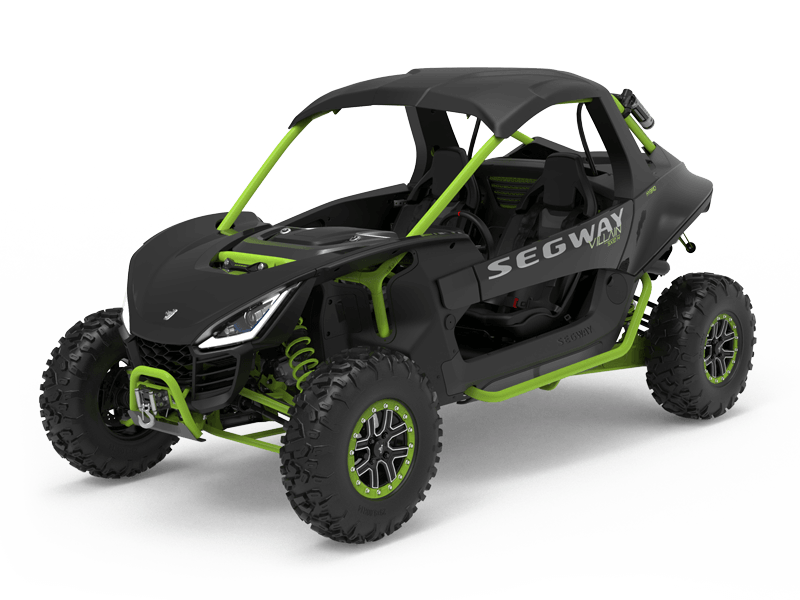
In the places where the Segway Villain did launch, it came in right in the middle of the pack price-wise. This proves that Segway has the desire to build machines that can compete on price with similarly equipped side-by-sides.
| Segway Villain | Polaris RZR Trail | Can-Am Maverick X3 DS Turbo | |
|---|---|---|---|
| Starting/Base Price | $16,899 | $15,999 | $21,999 |

While it’s not a one-to-one comparison, the prices for hybrid cars have been slowly decreasing (even without tax incentives and rebates) in the last 5 years or so, bringing them closer to the price of standard gasoline-powered vehicles.
Ideally this will be true of the Super Villain hybrid. We’ve got our fingers crossed that at least one of the Super Villains (hybrid or gas) will be competitive price-wise with similar side-by-sides.

If the Segway Super Villain can land lower than the Polaris RZR Pro R and the Can-Am Maverick R on price, it could seriously shake up the industry.
Now, if the price is closer to $30,000—Can-Am and Polaris may have some serious competition on their hands, regardless of their current dominance in the market.
However, if the Segway Super Villain blows the Can-Am Maverick R and Polaris RZR Pro R out of the water on the sticker price, well… Segway machines will probably remain a rarity on the trail.
Side-by-side owners are savvy shoppers that will take risks on new products if the value is there. And it certainly seems like Segway could deliver when it comes to value. But will they?

Hopefully, the Segway Super Villain will be able to compete on quality AND price with the Maverick R and the Pro R, but only time will tell. Regardless, Segway’s innovation is vital for the long-term future of our sport.
Maybe we’ll see more turbo-charged hybrid vehicles like the Segway Super Villain in the near future. The powerful acceleration and fuel efficiency hybrid UTVs can offer simply can’t be ignored.
When and if the hybrid side-by-sides of the future take over the trail, you know we’ll have all the aftermarket parts and accessories you need at SuperATV.com.



3 Comments
When will the super villain be out
Hi Anslee, thanks for reading! While Segway hasn’t confirmed a specific date, industry insiders expect the Super Villain to be available by the end of 2024, most likely in Q3 or Q4.
Where are these machines assembled / built?