
There’s nothing more startling than cruising through the woods on your quad and hearing a firecracker pop right at your rear end.
It’s also a sign that something’s wrong with your ATV. After all, backfiring belongs in black-and-white footage of Depression-era trucks, right?
So what causes your ATV to backfire, and what can you do to fix it? Let’s find out.
So what’s going on when your tailpipe pops? That’s caused by too much unused fuel ending up in your exhaust where it’s hot enough to ignite.
So when we’re looking for the root cause of a backfire, we’re actually looking for why there’s unburnt fuel in your exhaust.
The main culprits are:
We’ll explain each of these and see what you can do to fix them.
With all these different ways for your ATV to backfire, how do you figure out where the problem is coming from? If you start ripping out components willy-nilly, you’ll end up rebuilding half your machine and wasting a bunch of money.
So let’s take a more surgical approach and diagnose the problem before we start ripping out parts, starting with the most likely failure point.
A bad spark plug can misfire or skip firing altogether. When that happens, the unburnt fuel gets sent to your exhaust pipe and it explodes there instead of your cylinder. Here’s how to check it:
If your spark plugs look good, you should check your ignition before you thread them back in.
If your spark plugs look bad, odds are that there’s something else wrong that’s causing your fuel to run rich and damage it. So don’t stop checking just yet!

Another common failure point is the ignition coil. If you’ve already checked your spark plug, you can check if it’s getting power to your spark plug pretty easily with this tried-and-true garage method. Here’s how to check:
If that’s all good, you can move on to the more difficult checks.
Most newer quads use a fuel injector. You can tell if yours does because it will have EFI (Electronic Fuel Injection) on its spec sheet or written somewhere on the bodywork.
Fuel injectors are a little tougher to work with, so if you’re not comfortable finding and removing your fuel injector, it’s probably time to get a mechanic involved. That being said, you’ll never get more comfortable if you don’t give it a try! Just make sure you have the time and patience to make a few mistakes on the way.
Some ATVs will give you an EFI error code if it detects a problem, but if your fuel injector’s problem is mechanical and not electrical, it might not throw an error.
The trick is that a faulty or dirty fuel injector actuator can get stuck in the open position and let too much fuel into the cylinder, which can’t all burn and gets forced into your exhaust.
Here’s how to figure out if this is the issue:
If the devil’s in the details, say a prayer and sprinkle some holy water before you crack open your carburetor. There are lots of things that can go bad in a carburetor, and they’re all small.
First of all, if your carburetor looks grimy and dirty, it probably is. Disassemble your carburetor and spray it with carburetor cleaner. Then use a wire to clear out any wire-sized holes. Finally, spray it with compressed air (make sure you have eye protection on!) and reassemble.
Now check the float height.
If you have a plastic float, you’ll have to buy a new one if it’s measuring wrong.
If you suspect a previous owner has modified your carburetor, you should also compare the jet size to spec. If they’re too big, you’ll need to replace them with stock-size jets.

How can you tell if you’re backfiring from letting off the throttle too quickly? Just test it out.
Just go for a ride and pay attention to when it backfires. If it only happens when you’re heavy on the throttle then let go completely, that’s probably your problem.
But why does that happen?
First of all, it’s usually only possible in older ATVs without electronic fuel injection. On carbureted quads, full throttle means as much fuel as possible is passing through the carburetor. When you drop it quickly, extra fuel can get through before it has time to physically shut, resulting in a rich mixture. And when there’s not enough oxygen to burn that fuel completely, it gets shoved into the exhaust and boom.

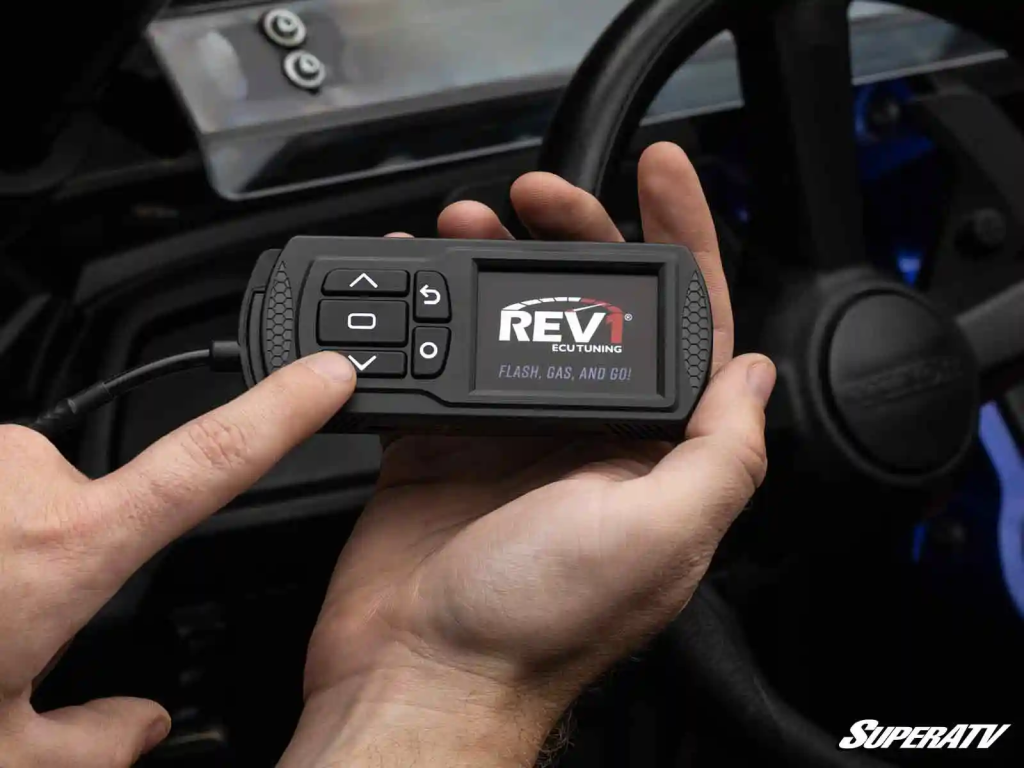
If you’ve recently bought and installed an ECU tune for your ATV, this is the first thing you should check out.
The quickest check is to reflash to a stock ECU tune and drive your machine around. If it stops backfiring, check with the tune’s manufacturer for a solution. Then give one of our tunes a try the next time.
If you don’t have an aftermarket tune and you’ve checked everything else and can’t get the backfiring to stop, you’ll have to take it into the shop. Ideally, they’ll be able to reflash your ECU to fix any bugs in the software and get your engine times and fuel mixture running right again.
As in all things mechanical, figuring out what’s wrong is the hard part. Once you’ve narrowed down the source of your backfiring to a specific component, remedying it is pretty straightforward.
You’ll find that most of the advice in this section falls into the “buy a new one and replace it” category.
You’ll notice that a lot of backfires are caused by components getting old, bad, and dirty. You can’t stop things from getting old, but you can keep them running smooth and keep grime out of your ATV.
Keeping up with your regular machine maintenance is key, but sometimes parts just go bad. If you want to get your ATV fixed up fast with high-quality, in-stock parts that cost a fraction of what the major manufacturers charge, then check out SuperATV’s Up & Running Parts.
They’re designed to get you out of the garage ASAP. And with our lightning-fast nationwide shipping, they’ll be at your front door before your neighbors can complain about your backfiring ATV.




2 Comments
My John Deere ATV only backfires when I turn it off, what is the problem?
Hey Andy,
If your John Deere ATV only backfires when you shut it off, it’s usually because unburned fuel is igniting in the exhaust as the engine stops. This is commonly caused by a slightly rich fuel mixture, the idle speed being set too high, a small exhaust leak, or normal heat soaking in the exhaust system. In most cases it’s harmless, but if it’s loud or frequent, checking the idle adjustment, fuel system, and exhaust seals can help fix it.