Every complex machine has complex problems. That includes your Polaris RZR. But the good news is that you don’t have to figure out those problems on your own. Unless you’re RZR decides to break down in a really unique way, there’s plenty of information on how to fix what ails ya and your RZR.
So read on! We’re covering all the most common problems your RZR can face. It’s the perfect primer for any new rider, and a good refresher for everybody else.
What Polaris RZR Owners Need to Know
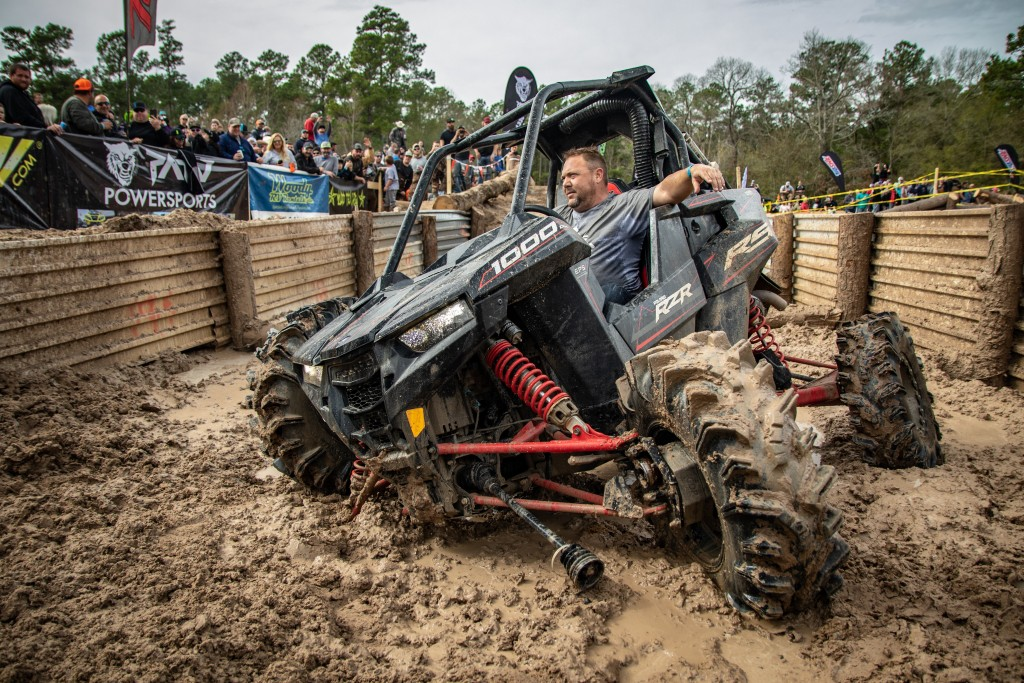
Your RZR goes through (or will go through) a lot. From muddy creek crossings to intense hill climbs to flat-out, full-speed riding in dust and sand, it’s gonna take a beating.
Basically, if you’re having fun, your RZR probably isn’t.
That’s why it’s so important to keep up with common maintenance procedures and make sure you’re aware of common issues that might pop up. Make sure you know them, so you know when to stop and fix something before the problem gets bigger.
Engine Overheating Issues
When you’re engine starts to overheat, you’ll know it from the sudden loss of power. That’s because your RZR will automatically go into limp mode to prevent damage.
There are a few things that frequently cause overheating:
Clogged Radiator—Mud, grass, and other debris can stick to your radiator and prevent air from passing through it, leading to overheating.
Damaged Coolant Lines—If a piece of debris like a tree branch gets through your skid plate, it can damage your coolant lines and cause a leak.
Water Pump Failure—A faulty water pump will stop the coolant from circulating and lead to overheating.
Hot Weather and Extended High RPM—Your RZR will normally handle hot weather just fine, but if it’s especially hot and you push your machine especially hard, it can overheat.
How to Fix Overheating
Getting back to running cool is pretty straightforward.
For a clogged radiator, clean it! And consider upgrading your grille for more protection.
If you have damaged coolant on the trail, you can try to plug the leak, but your priority should be to get back to the trailer and replace any damaged line ASAP. You’ll probably need a tow.
If your water pump fails, your coolant will be stagnant, and the only way to fix it is by replacing it. Get back to the trailer with a tow and get it replaced.
If you’re running at high RPM on a hot day and get kicked into limp mode, slow down and let your RZR cool off. Then don’t keep your foot to the floor when you get going again.
A grille protects your radiator from sticks, branches, and other debris. Plus, they look awesome. Photo by Assault Industries
Transmission and Clutch System Failures
Sudden power loss from a transmission or clutch system failure can be pretty alarming. It might feel like jerky, uneven acceleration or just a total loss of power from the throttle. If you’re clutch fails, you’ll still get high RPMs too—you just won’t go anywhere.
Here’s how to tell what’s going on:
Clutch Belt Failure—A failing clutch belt will slip and cause jerky acceleration. You might also smell burning rubber. When it fails completely, the power transfer will stop. You won’t be able to accelerate, reverse, or do anything else.
Reverse Chain Failure—Another common failure point is the reverse chain in the transmission. Often, your only clue is a loud pop when you’re in reverse, then a complete lack of reverse power. You can still move forward, but you’ll have to take it easy since you’ll have to winch in reverse any time you get stuck. It’s not impossible for a broken reverse chain to damage your transmission housing too, which can determine if you see oil pouring out of the bottom of the machine. Newer RZRs don’t have a reverse chain.
How to Fix Transmission and Clutch System Issues
If you have a belt or reverse chain failure, here’s what you need to do:
If your belt fails, you need to replace your clutch belt. If you have a spare belt and the right tools, this can be pretty quick and easy to do on the trail. Otherwise, you’ll have to get a tow back to your trailer. If your belts aren’t holding up to your rides, upgrade to a heavy-duty Gboost drive belt.
If your reverse chain breaks, first check for oil leaking from your transmission. If there’s none, crawl back to your trailer as carefully as possible. Remember: you have a broken chain loose in your transmission, so take it easy to avoid damage. Finally, upgrade to our heavy-duty reverse chain or our geared-reverse transmission.
Our geared reverse transmission is wild. It completely eliminates the reverse chain and beefs up a bunch of components. It’s a massive upgrade that will keep kicking way longer than stock. Photo by SuperATV
Electrical Problems
Electrical problems almost always make themselves known when you try to start your engine. Typically, you’ll turn your key, and there won’t be enough power to start your engine. Or if there’s really no power, it might just click without turning over at all.
Either way, it means your battery doesn’t have enough juice. Here are the most common reasons why:
Your Battery Is Old—Check the date on your battery. If it’s more than two years old, it’s probably time to replace it.
Check Your Accessories—You should have your accessories wired to only come on when the key is on, but if you’ve left a light on, it could drain your battery. If you have something more intense, like power steering or a winch that isn’t wired into a keyed-on wire, they can continuously drain your battery, even when it’s off.
Bad Stator—Your stator charges your battery as you ride. If it goes bad, you’ll notice it getting harder and harder to start your engine until it just won’t start at all.
How to Fix Electrical Problems
Dealing with a dead battery isn’t too hard. Just remember that unless you’re replacing your battery, you’ve got to jump it after you fix the problem.
If your battery has expired, get a new one! Easy peasy.
If you left a light on. Turn it off and jump your battery. If you have persistent power problems and suspect that accessories are drawing power even when the machine’s off, you’ll want to check whatever accessory was last installed to make sure it’s wired into a keyed-on power source.
If you’re battery holds a charge but dies after several starts and rides, your stator may be failing to charge it. Get a new Up & Running Stator to get fixed up.
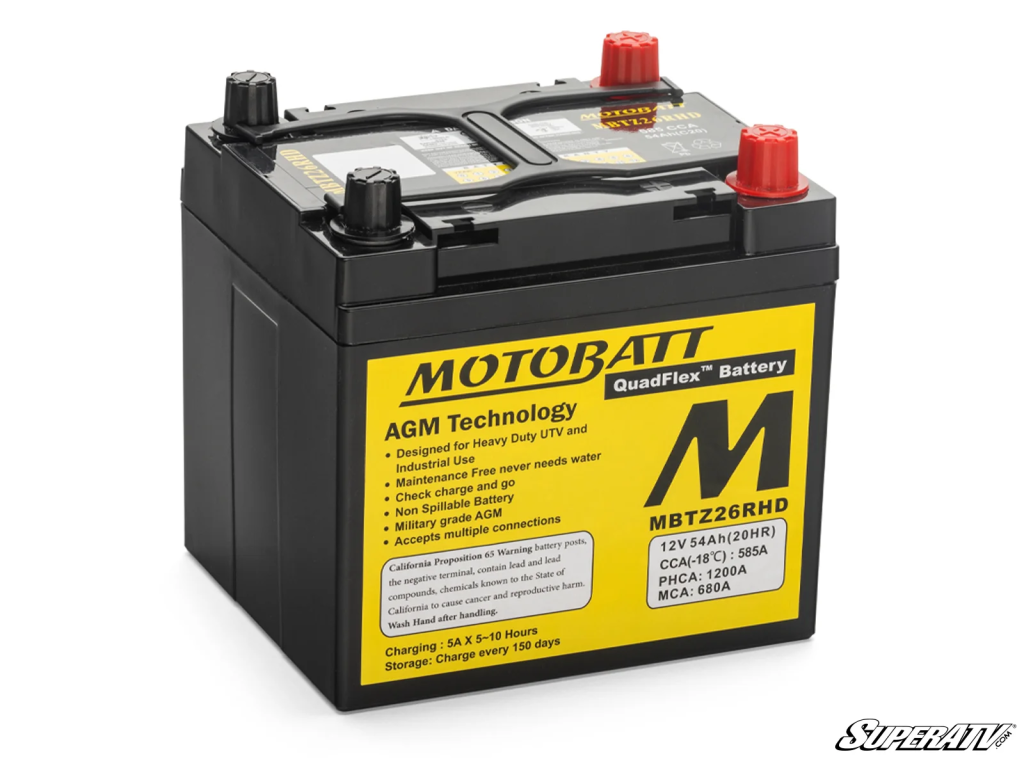
Got a dead battery? We’ve got you covered with Motobatt batteries that are designed to handle off-road use. Photo by SuperATV
Suspension Wear and Tear
Your suspension takes a beating on every ride. That means your ball joints, wheel bearings, bushings, and shocks are some of the first items to wear out.
They’ll wear out even quicker if you ride in especially muddy, wet, or dusty environments. Look out for wobbly tires and knuckles to spot ball joint and bearing issues. Wobbly and clunky A-arms point to worn bushings. If you start losing ground clearance, your shocks might be wearing out.
Here’s how to fix them.
How to Fix Suspension Issues
Luckily, most of the wear and tear on your suspension goes straight into wear items, so replacing them is easy.
Shocks going bad? This one’s tougher. If you’re shocks are leaking oil, they’re done. You’ll have to get some new ones. If there’s no oil and your shocks are pretty old, you might need to replace only your springs.
Steering Rack and Tie Rod Failures
Steering racks wear out and tie rod ends snap. That’s just how off-roading goes.
A broken tie rod or tie rod end—If a tie rod or tie rod end snaps, you’ll know it right away because one of your wheels will start pointing in the wrong direction. Which is bad.
A worn tie rod end—Worn tie rod ends introduce slop into your steering. Every time you turn your steering wheel, it’ll move a bit before your front wheels start to turn. You can confirm a bad tie rod end by jacking up your machine, grabbing your tire at nine and three positions, and wobbling it back and forth. Get another set of eyes to check the tie rod end and visually see if the bolt is moving in the tie rod end.
A worn rack—A worn rack can feel similar to a worn tie rod end. It can feel like extra play when you try to turn. Your UTV could wander left or right when you feel like you’re driving straight. There might also be clunking sounds when you turn and oil leaking from the rack.
How to Fix Rack and Tie Rod Problems
You don’t want to mess around when your steering system goes bad. When you spot a problem, fix it up right away to avoid a big accident on the trail.
If you have tie rod end issues or a broken tie rod, upgrade to heavy-duty tie rods that use beefed-up tie rod ends.
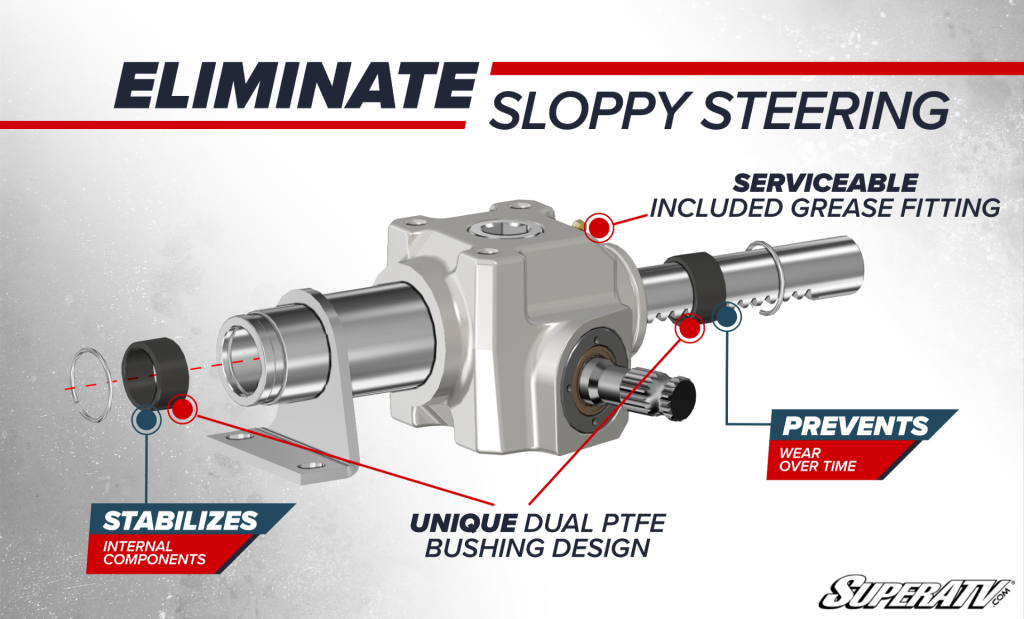
If your rack is worn out, it’s the perfect time to upgrade to a RackBoss 2.0, which includes tie rods and ends. RackBoss 2.0 wears at less than half the rate of a stock rack thanks to our patented X24. It’ll give you peace of mind for thousands of miles to come.
RackBoss 2.0 changes the game when it comes to rack wear. Its dual-bushing design reduces wear and tear by over 50% compared to stock. It’s a killer upgrade if you need a new rack. Image by SuperATV
Drivetrain & Axle Problems
Axle and drivetrain issues are rarely terminal for your ride, but they do suck all the fun out of your weekend if you don’t fix them. That’s because most side-by-sides run just fine in two-wheel drive when a prop shaft, differential, or axle problem pops up.
But is two-wheel drive fun? No. Unless you have some nice scenery to cruise by.
Here are the common failure points:
Axle failures—Clicking coming from your axles is an early sign of failure. It may run normally for a while, or it might break in the next five minutes. Leaking grease from your axle boots will appear like a dusty, dirty smear, and it will lead to failure soon. If your boots are bunched up, it’s already broken
Prop shaft failures—If you feel a big vibration right up your backside, it’s a sign that the U-joints on your prop shaft are going bad. If you have no four-wheel drive at all, it’s a good sign that your prop shaft is broken.
Front differential failure—It’s hard to spot a front diff failure, but it could cause your four-wheel drive or diff lock to be engaged permanently. It’s more likely that you won’t have four-wheel drive at all, though.
How to Fix Drivetrain & Axle Problems
Even though you can drive with axle or drivetrain problems, you’ll want to head to the trailer (with a little help from your buddies) because it’s easy to get stuck if you don’t have four-wheel drive.
If you have a broken or failing axle, you should replace it with a new axle. Many riders bring a spare. If you think you’ve got the skills, you can save a few bucks by replacing only the CV joint.
When your prop shaft’s U-joint starts to vibrate, you can usually get away with just replacing the joint itself. It might be a good idea to upgrade your prop shaft, which is what you’ll be doing if it’s broken.
Depending on how your RZR’s front diff fails, you’ll have to fix it in different ways. If your case is intact, you’ll probably just have to replace your sprague carrier. If the case is broken, you’ll need a complete front differential.
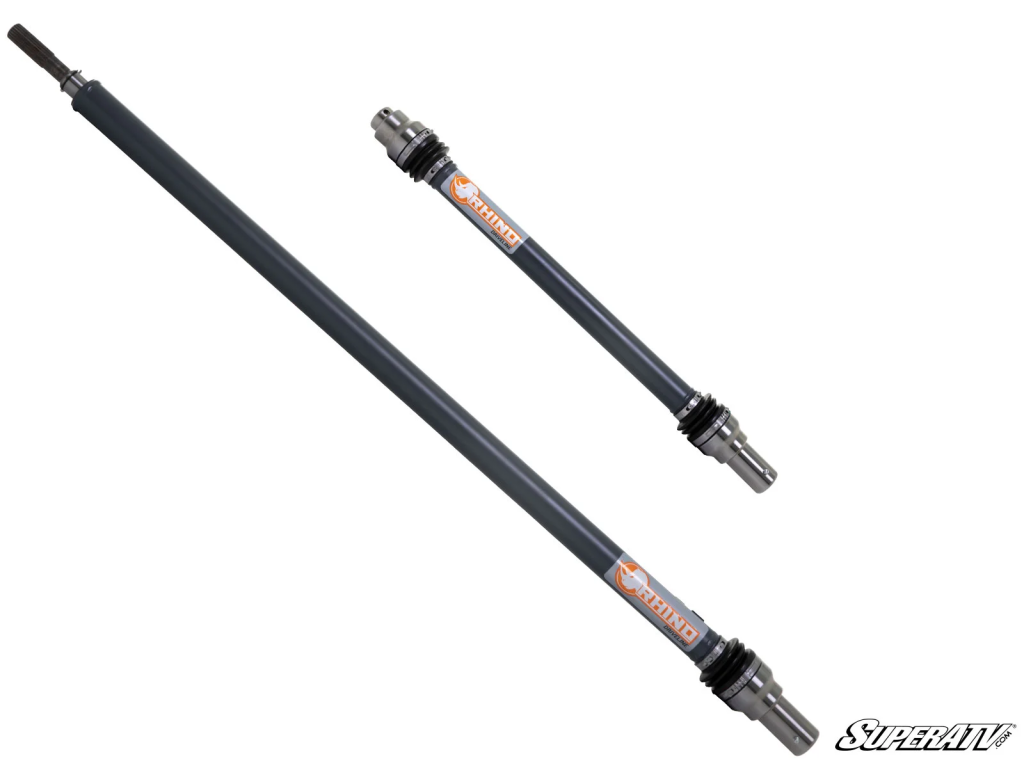
These C-Series Rhino Driveline Prop Shafts use CV joints rather than typical U-joints. That means they’re more durable and more protected than your stock prop shaft. It’s an ideal upgrade if you have prop shaft problems. Photo by SuperATV
Braking System Shortcomings
Brake problems are among the most serious problems a RZR can have. After all, without brakes, your RZR is just a big dummy missile.
Brake pad wear—Brake pad wear is normal, and as your pads reach the end of their life, they’ll squeal. They could also squeal when wet, but that will stop after several braking cycles.
Warped Rotor—You can feel a warped rotor in the brake pedal. It’ll feel like brake pressure increasing and decreasing as you roll. This can lead to quicker pad wear or damaged calipers if it’s severe enough.
Brake line or caliper failure—If your caliper or brake lines are damaged and leaking fluid, you’ll notice your brake pedal suddenly become softer and that it takes longer to stop. You should stop immediately if you notice a suddenly soft pedal.
How to Fix Braking System Issues
So how do you handle brake system problems? It’s pretty straightforward.
When your brake pads start squealing, get new brake pads and replace them.
If your rotor is warped, you need to take it to a shop. It might need to be resurfaced or replaced.
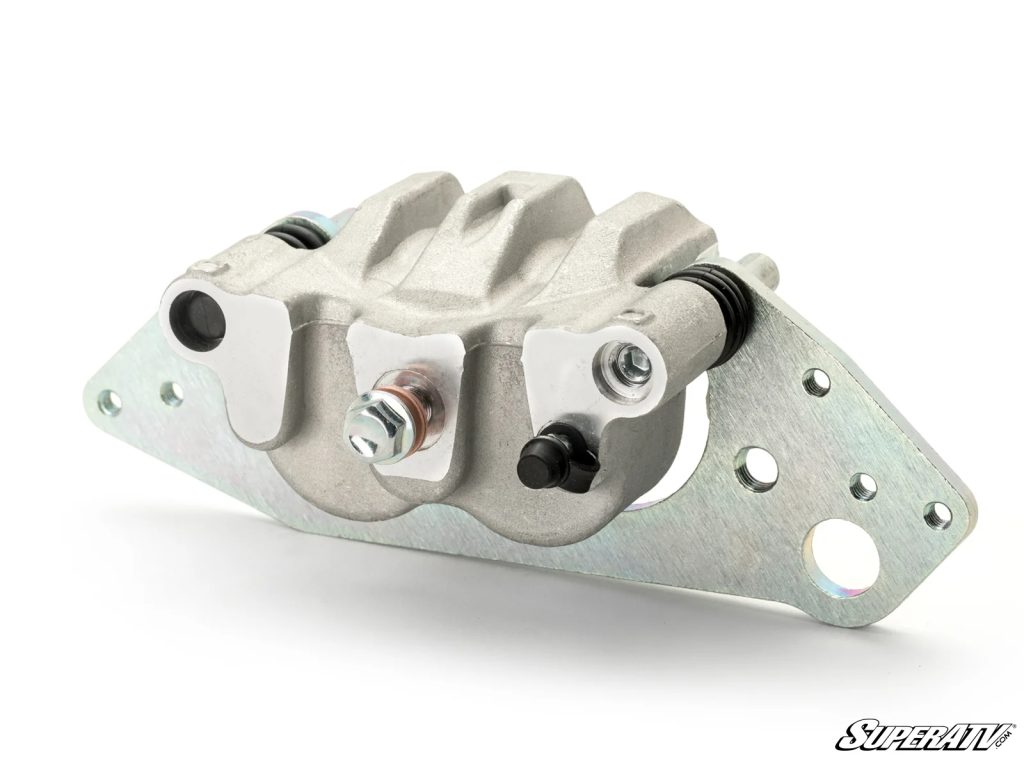
If you have a brake line or caliper, don’t ride it and tow it to the trailer and take it to the shop. It needs to be fixed. We have RZR brake calipers to fix it up.
Our Up & Running brake calipers are designed to match OEM quality at a fraction of the price. Plus, you get that lightning-fast SuperATV shipping that can get it to your door in two days or less. Photo by SuperATV
Keep Your RZR Running Like a Beast
It’s important to listen to your RZR’s cues and check them out. Address them quickly so they don’t become big problems. Plus, odds are they’re not too tough to replace on your own.
My 2013 Polaris Rzr 800s will not engage 4 wheel drive . We have one broke axel in the back we are replacing but we just put a brand new front differential in. It wouldn’t go in forward gear but would reverse. It did make a pop sound every time we tried to go in forwards gear. What could possibly be the problem with it? The front differential housing is not broken but could something possibly be broke inside causing the pop noise ? When we unloaded it into the car port it came right off and drove normal without popping but 4 wheel drive wouldn’t engage , could it be electrical and water got into the switch because it’s not sealed properly or could it be the axel or a problem with the differential internals ?
I’m just trying to get the kinks worked out of her and it’s been rough lol! Thanks – Madison
Hi Madison, The pop noise you’re hearing usually points to something mechanical, like a misaligned or damaged gear inside the front differential or an axle that isn’t fully seated, and since 4WD won’t engage even with a new front diff, it could also be an electrical issue like a wet or faulty 4WD switch or actuator. It’s possible the axle or CV joints are causing the pop, and the 4WD problem could be separate, so make sure the new diff and axles are installed correctly, check for any broken internals, and inspect the switch and actuator for water damage or corrosion.
Hey Joey, That “bouncy” or twitchy throttle on a 2008 RZR 800 is actually pretty common, and it’s usually not something a stronger spring or different cable fixes.
I have a 2016 rzr 900 that was running fine, I was riding and out of no where started bogging and acts like it’s in limo mode without throwing a code, I replaced tamp-brake switch sensor and even put a seatbelt override sensor. Has fuel pressure, both injectors are working, I can’t figure it out. If I floor it it’ll suck crazy air but seems like not enough fuel. It eventually threw a code for tps and pps but that’s after I messed with it a little…
I also have a ranger 900 on 42’s that’s doing the same thing and has never had the motor in water
Hey Evan, I’d focus on the TPS/PPS wiring and connectors first. A bad signal there can put the RZR into limp mode without immediately throwing a code. Since both machines are doing it, an electrical/throttle issue seems more likely than a fuel problem.




8 Comments
My 2013 Polaris Rzr 800s will not engage 4 wheel drive . We have one broke axel in the back we are replacing but we just put a brand new front differential in. It wouldn’t go in forward gear but would reverse. It did make a pop sound every time we tried to go in forwards gear. What could possibly be the problem with it? The front differential housing is not broken but could something possibly be broke inside causing the pop noise ? When we unloaded it into the car port it came right off and drove normal without popping but 4 wheel drive wouldn’t engage , could it be electrical and water got into the switch because it’s not sealed properly or could it be the axel or a problem with the differential internals ?
I’m just trying to get the kinks worked out of her and it’s been rough lol! Thanks – Madison
Hi Madison,
The pop noise you’re hearing usually points to something mechanical, like a misaligned or damaged gear inside the front differential or an axle that isn’t fully seated, and since 4WD won’t engage even with a new front diff, it could also be an electrical issue like a wet or faulty 4WD switch or actuator. It’s possible the axle or CV joints are causing the pop, and the 4WD problem could be separate, so make sure the new diff and axles are installed correctly, check for any broken internals, and inspect the switch and actuator for water damage or corrosion.
How do you fix the bouncy throttle on 2008 RZR800. Is there a throttle cable replacement with a stronger spring or am I stuck with it?
Hey Joey,
That “bouncy” or twitchy throttle on a 2008 RZR 800 is actually pretty common, and it’s usually not something a stronger spring or different cable fixes.
2022 rzr pro xp4 will not go in 4 wheel drive, the switch lights up but doesn’t show 4 x 4 light.
Hey William,
Give us a call to speak with a technician! 812.574.7777
I have a 2016 rzr 900 that was running fine, I was riding and out of no where started bogging and acts like it’s in limo mode without throwing a code, I replaced tamp-brake switch sensor and even put a seatbelt override sensor. Has fuel pressure, both injectors are working, I can’t figure it out. If I floor it it’ll suck crazy air but seems like not enough fuel. It eventually threw a code for tps and pps but that’s after I messed with it a little…
I also have a ranger 900 on 42’s that’s doing the same thing and has never had the motor in water
Hey Evan,
I’d focus on the TPS/PPS wiring and connectors first. A bad signal there can put the RZR into limp mode without immediately throwing a code. Since both machines are doing it, an electrical/throttle issue seems more likely than a fuel problem.