
You can point to different periods of side-by-side history and clearly see a dominant trend that all the manufacturers chased. First, everybody made work-focused UTVs like the Pioneer, MULE, and Ranger. Then, the Ranger RZR, Maverick, and Wildcat brought a sportier side to them. Later, more crossovers hit the scene in the mid-2010s. Then there were turbos, advanced active suspension, fancy dashboards, and the chase for the most horsepower that’s still going on today.
And now we’re starting to see a new trend emerge: electric-powered UTVs.
There are basic EV Rangers, lots of other low-power utility-focused EVs, the high-end Ranger Kinetic, and the all-new Segway Super Villain hybrid. Electric UTVs are a broad category that demands a closer look.
So we’re gonna dig into all this electric UTV stuff to make sure you know everything there is to know about it, so you can decide if your next UTV is an electric one.
Electric UTVs wouldn’t exist if there wasn’t some problem that they solve. And these things solve quite a few.
The near silence of the motor is by far the biggest advantage of having an electric side-by-side. It makes conversations easier while you ride, and it makes it easier to enjoy the sounds of nature.
But hunters will enjoy it most of all.
Hunters with an electric UTV can:
Its application is pretty obvious—stealthy hunters need a stealthy machine. And nothing’s stealthier than an EV.
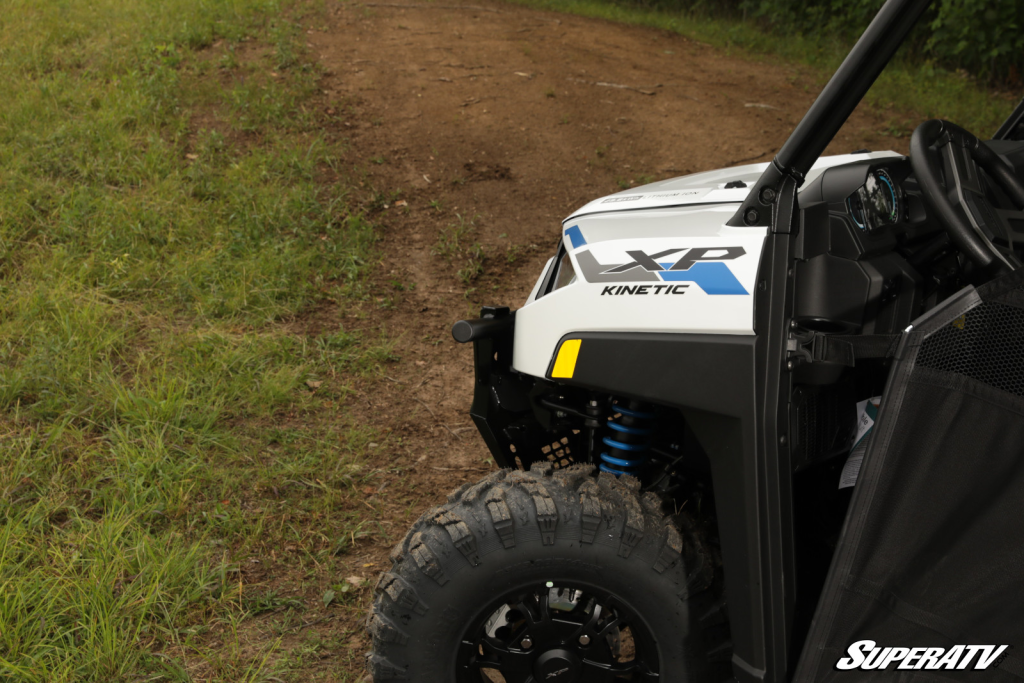
Electric vehicles never have to go to the gas station, which saves you tons of money. But your electricity isn’t free, so let’s compare a Ranger XP 1000 and a Ranger XP Kinetic to see just how much you save by making this awkward comparison a little more apples-to-apples.
If gas costs $3 per gallon, and you get about 20 mpg on your Ranger XP 1000, that works out to about $0.15 per mile to drive an XP 1000.
The Ranger XP Kinetic advertises an 80-mile range per 29.8 kWh charge, and the national average electricity rate is $0.23 per kWh. That means it costs about $0.09 per mile to drive a Kinetic.
So fueling a Kinetic isn’t free, but it is only 60% of the cost of gassing up a Ranger XP 1000. That’s a pretty huge savings.
Electric motors have a huge torque advantage compared to internal combustion engines. That’s how you get electric vehicles like the Ranger XP Kinetic that pump out 150 lb.-ft. of torque the instant you hit the gas.
That’s a huge amount of power, and the fact that it doesn’t have to wait for your RPM to get to the sweet spot means it’s got better power than just about any gas-powered UTV on the market.
Even Polaris’s humble 30 HP Ranger EV produces 113 lb.-ft. of instant torque.
That’s pretty punchy for a little guy.

An all-electric powertrain means less regular maintenance—you can forget about engine oil changes.
Some models use regenerative brakes, which reduces the wear on their brake pads too.
You’ll still have to worry about transmission oil, differential oil, and wear parts like bearings, but overall, there are fewer moving parts on an electric UTV, so there’s usually less downtime for maintenance.
Electric UTVs aren’t some miracle technology from heaven that’s better in every way. If you switch to an EV, you’ll be giving up some features you might’ve taken for granted before.
The most obvious problem with electric UTVs is their range. The Ranger XP Kinetic Ultimate has the most range of all of them currently, and even its big battery only gets 80 miles per charge. Compare that to a Ranger XP 1000 that gets about 230 miles on a full tank.
And it’s not like you can just run it over to the gas station really quick and charge it up either. Filling that battery, even with a fast charger, takes up to five hours.
How long does filling up a ten-gallon gas tank take? Two minutes on a slow pump?
The range is a tough one to swallow, and if you plan on using an EV, you have to plan your recreational rides around your battery. That’s why most EVs make more sense for use on farms and larger properties with a lot of starting and stopping rather than on wild backwoods adventures.
Of course, you can skirt the range problem with a hybrid, but we’ll talk more about that later.
Electric UTVs tend to weigh more than their gas-powered counterparts. Most of that weight comes from the inclusion of heavy batteries that are essentially just giant hunks of metal.
More weight makes them a little bit tougher to handle and makes it easier to get bogged down in mud, sand, or any other soft terrain.
The last big issue with EV UTVs is their cost.
We’ll start with the elephant in the room: the cheapest 45-mile-range Ranger XP Kinetic Premium starts at $24,999 MSRP. The Ultimate, with its 80-mile range, starts at $29,999 MSRP. For comparison, you can get a fully kitted-out Ranger XP 1000 Northstar Edition for $27,899 and a base Ranger XP 1000 for $20,299.
That’s about a $5,000 premium for the Kinetic.
But that’s the Kinetic.
Less premium EVs like the 2022 Ranger EV, the Hisun Sector E1, and the Tracker EV IS are much more comparable to their gas-guzzling cousins, both in price and performance. These more budget-friendly models don’t use lithium ion batteries like the Kinetic. Instead, they use lead-acid batteries that take longer to charge and generally give you less range, though specs vary by machine.
As time goes on, we expect the price difference between EVs and gas-powered machines to get smaller and smaller. Right now, though, it’s still an expensive choice.
The range of electric UTVs on the market is still pretty limited, but it is steadily growing and evolving.
Segway promised hybrid UTVs all the way back in 2019, but only recently announced their first actual hybrid model, the Segway Super Villain.
The Segway Super Villain is a promising addition to the UTV industry. Its hybrid drivetrain delivers a boatload of horsepower and torque that kinda blows other sport side-by-sides out of the water.
Hybrids are ideal for a few reasons:
The Segway Super Villain is very cool, and the coolest thing about it is that it saves you money at the gas pump and gives you all that wild electric power you love. It doesn’t seem like a quiet machine though, but then again, this thing is built for throwing rooster tails and blazing trails rather than putting around the yard.

Electric UTVs are on the rise, and they’re a serious contender for your hard-earned cash. They’re not gimmicks or fads—they’re something worth considering.
Hopefully by now you know if they’re something you could see yourself driving or not by now. We expect to see more and more EVs and hybrids popping up over the next decade. And if one does manage to find its way into your shop, you know SuperATV will be the first one with a full suite of upgrades for it.



4 Comments
My 2007 utv electric runs for some time and then shuts down. After setting a few
Minutes it will start working again. Any suggestions? Batteries are good
We use it spraying etc on a farm
Hey Gary!
Give us a call and a technician can help you get to the bottom of it. 812.574.7777 You can also sign up for our virtual mechanic! You would be able to work with a technician on a video call. https://www.superatv.com/virtual-mechanic
I have a 2008 Bad Boy UTV with 8-yr old batteries; plenty of torque but little range. I would like to trade or sell. Do I have any options?
Hey Bill,
You might try and sell it online. Thanks for reaching out!